Ultra-High-Resolution Astronomy with the Solar Gravitational Lens

Ultra-High-Resolution Astronomy with the Solar Gravitational Lens
Slava G. Turyshev
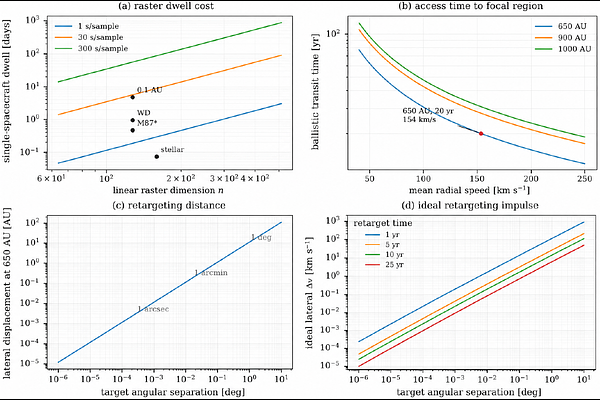
AbstractThe solar gravitational lens (SGL) is a target-specific observatory: the Sun supplies the wave-optical element, while spacecraft provide occultation, annular photometry, sampling, metrology, and inverse reconstruction. We develop an observability framework for non-exoplanet SGL astronomy. Viability is set by image-plane scale, raster pitch, finite-source gain, source-to-background ratio, temporal coherence, PSF knowledge, calibration, metrology, and focal-line access. We separate the vector Poisson measurement operator from the scalar convolution used for benchmarks. Four analytic scenes are propagated and reconstructed: a solar analog and magnetic white dwarf at 10 pc, an M87*-scale millimeter ring/jet source, and a bright 0.1 AU protoplanetary subfield at 140 pc. Under stated kernel-mismatch, background, calibration-floor, support-mask, sampling, regularization, and imposed information-floor assumptions, the scalar reconstructions give SSIM values of 0.993, 0.918, 0.973, and 0.923. These metrics quantify scalar inverse conditioning, not delivered flight performance; FRC50, support-leakage, and information-floor sensitivity diagnostics expose the dependence on assumptions. Many self-luminous compact targets are not photon-starved relative to a reflected-light exo-Earth reference, shifting the dominant requirements to ring extraction, coronal subtraction, detector dynamic range, PSF knowledge, cadence, spectroscopy, metrology, scan overhead, and access. The strongest bounded cases are white-dwarf surface and magnetic mapping, nearby stellar surfaces, compact AGN/black-hole structure with long-wavelength instrumentation, velocity-resolved broad-line-region mapping, and planet-forming subfields. The priority enabling program is SGL transfer-function characterization: measuring solar-multipole, plasma, extended-Sun, and instrumental response needed for scientifically interpretable imaging.