Quantum optimal control of the Dicke manifold in Rydberg atom arrays

Quantum optimal control of the Dicke manifold in Rydberg atom arrays
Ivy Pannier-Günther, Vikas Buchemmavari, Pablo M. Poggi, Ivan H. Deutsch
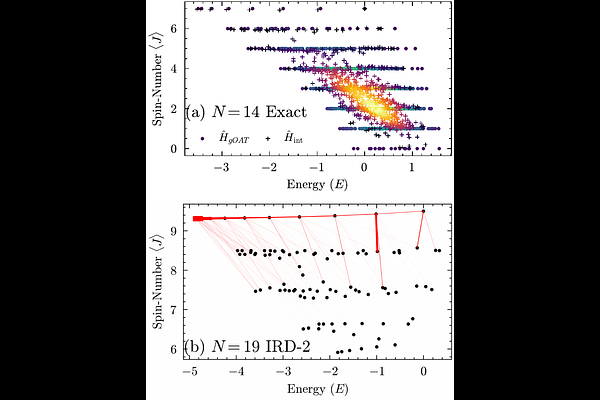
AbstractThe ability to engineer and control quantum states of many-body systems is a central challenge in quantum information science. For a register of $N$ qubits, the full Hilbert space dimension grows exponentially as $2^N$, rendering generic state preparation and control infeasible without exploiting structure or symmetry. A particularly important and physically motivated restriction is to the fully symmetric subspace, spanned by the Dicke states, which are simultaneous eigenstates of collective spin $J=N/2$. Ensembles of Rydberg atoms interacting via electric dipoles in two-dimensional tweezer arrays form a promising platform for achieving such control. However, the finite range of dipole-dipole interactions poses a challenge to generating and controlling the Dicke manifold because the Hamiltonian incurs leakage from the computational subspace. To counteract this leakage, we perform quantum optimal control algorithms on a truncated Hilbert space according to our newly developed method of ``irrep distillation'' (IRD), which captures the process by which the symmetric subspace couples to leakage error-spaces, using only linear-scaling Hilbert dimension. We implement gradient ascent pulse engineering (GrAPE) on control schemes with little or no local addressing, to generate resourceful states like Greenberger-Horne-Zeilinger, Dicke, and extremal quantum states. We benchmark each scheme of IRD-GrAPE for its quantum speed limit (QSL), as well as exactly testing pulse fidelities on small system sizes and predicting fidelities using higher-order IRD on larger systems.