Millisecond-Scale Calibration and Benchmarking of Superconducting Qubits

Millisecond-Scale Calibration and Benchmarking of Superconducting Qubits
Malthe A. Marciniak, Rune T. Birke, Johann B. Severin, Fabrizio Berritta, Daniel Kjær, Filip Nilsson, Smitha N. Themadath, Sangeeth Kallatt, James L. Webb, Kristoffer Bentsen, Tonny Madsen, Zhenhai Sun, Svend Krøjer, Christopher W. Warren, Jacob Hastrup, Morten Kjaergaard
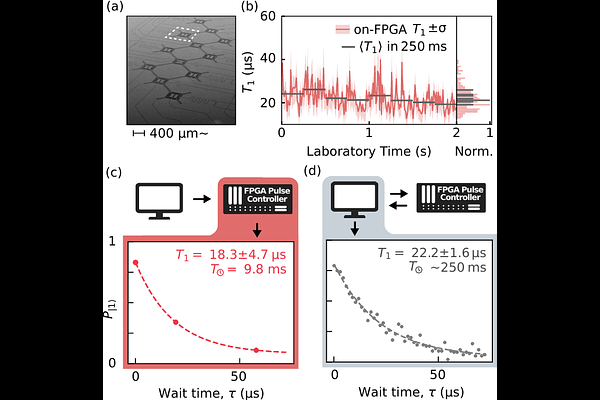
AbstractSuperconducting qubit parameters drift on sub-second timescales, motivating calibration and benchmarking techniques that can be executed on millisecond timescales. We demonstrate an on-FPGA workflow that co-locates pulse generation, data acquisition, analysis, and feed-forward, eliminating CPU round trips. Within this workflow, we introduce sparse-sampling and on-FPGA inference tools, including computationally efficient methods for estimation of exponential and sine-like response functions, as well as on-FPGA implementations of Nelder-Mead optimization and golden-section search. These methods enable low-latency primitives for readout calibration, spectroscopy, pulse-amplitude calibration, coherence estimation, and benchmarking. We deploy this toolset to estimate $T_1$ in 10 ms, optimize readout parameters in 100 ms, optimize pulse amplitudes in 1 ms, and perform Clifford randomized gate benchmarking in 107 ms on a flux-tunable superconducting transmon qubit. Running a closed-loop on-FPGA recalibration protocol continuously for 6 hours enables more than 74,000 consecutive recalibrations and yields gate errors that consistently retain better performance than the baseline initial calibration. Correlation analysis shows that recalibration suppresses coupling of gate error to control-parameter drift while preserving a coherence-linked performance. Finally, we quantify uncertainty versus time-to-decision under our sparse sampling approaches and identify optimal parameter regimes for efficient estimation of qubit and pulse parameters.