FRANZ: Framework for analytical one-zone blastwave dynamics

FRANZ: Framework for analytical one-zone blastwave dynamics
Leonard E. C. Romano
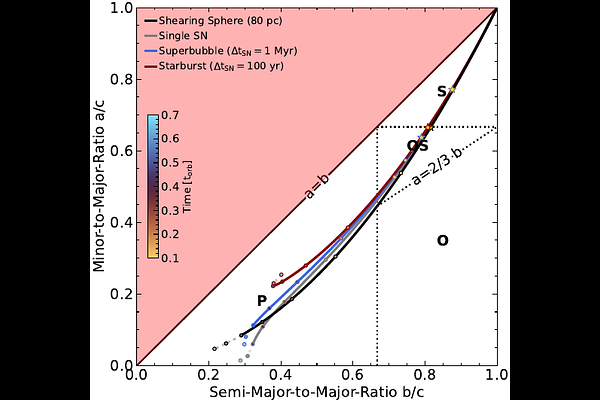
Abstract(abridged) We develop a flexible analytical framework for modeling blastwave evolution in arbitrary environments and use it to investigate how large-scale galactic structure affects the dynamics and morphology of evolved SNRs and SBs. We introduce FRANZ (FRamework for ANalytical one-Zone blastwave dynamics), a modular thin-shell model that follows the local evolution of a shock-surface segment in environments characterized by arbitrary density, velocity and gravitational fields. After validating the model against well-established analytical results, we apply it to study the effects of vertical stratification, galactic shear and dense galactic substructure on blastwave evolution. FRANZ reproduces the classical evolution of blastwaves in uniform media while extending to complex environments. We derive criteria for disk break out in stratified media, characterize the timescales on which differential rotation deforms blastwaves and identify a new mechanism, by which it can suppress the momentum coupling in continuously-driven blastwaves. Interactions with dense filaments modify both shock-surface morphology and dynamics and confound the interpretation of the expansion history of observed remnants, which depends on the density distribution prior to the onset of explosions, which is fundamentally inaccessible from the observed state. In highly structured media with a high volume-filling factor of diffuse gas, ages inferred from the observed state may be systematically overestimated. FRANZ provides a computationally inexpensive and extensible framework for studying blastwaves in realistic galactic environments. It offers a useful complement to numerical simulations for interpreting observations of evolved SNRs and SBs and for developing improved models of stellar feedback in large-scale simulations.