CausticFlow: An Efficient Machine Learning Framework Combining Neural Differential Equations and Normalizing Flows for Binary Microlensing Parameter Inference

CausticFlow: An Efficient Machine Learning Framework Combining Neural Differential Equations and Normalizing Flows for Binary Microlensing Parameter Inference
Haibin Ren, Wei Zhu
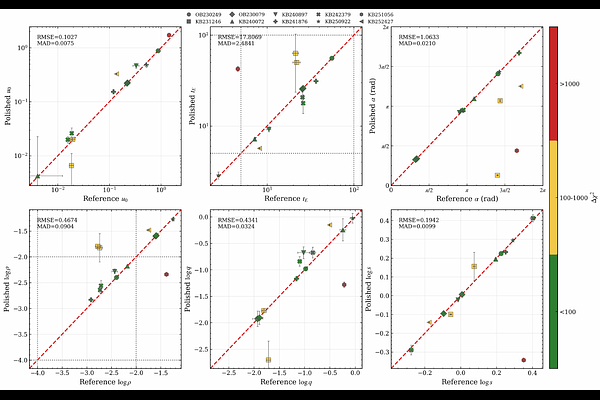
AbstractWe introduce CausticFlow, a machine learning framework that combines neural controlled differential equations with normalizing flows to infer binary microlensing parameters. This architecture naturally handles irregularly sampled time series and data gaps while flexibly capturing strongly correlated and multimodal posterior distributions. Trained on simulated KMTNet-like light curves, CausticFlow generates posterior samples in a fraction of a second, with maximum-a-posteriori estimates achieving typical precisions of $\sim17\%$ for the mass ratio $q$ and $\sim3\%$ for the projected separation $s$. When used as a proposal distribution for downstream local optimization, the framework improves these precisions to $<5\%$ and $<1\%$, respectively, and recovers model $χ^2$ for $\sim80\%$ of simulated events. We test the generalizability of the framework on 10 real binary lensing events characterized by higher-order effects, varied cadences, and real-world noise. Despite these mismatches between simulation and reality, CausticFlow successfully recovers the model parameters, light-curve morphology, and lensing geometry for 7 of the 10 events after simple local refinement, achieving precision levels comparable to those found for simulated data in 10 CPU minutes per event. These results demonstrate that CausticFlow acts as a fast and robust proposal engine, bridging the gap between the rapid influx of data and the need for systematic modeling in large-scale microlensing surveys such as Roman, CSST, and ET.