Neutrino mass limits and decaying dark matter: background evolution versus perturbations

Neutrino mass limits and decaying dark matter: background evolution versus perturbations
Thomas Montandon, Vivian Poulin, Thomas Rink, Thomas Schwetz
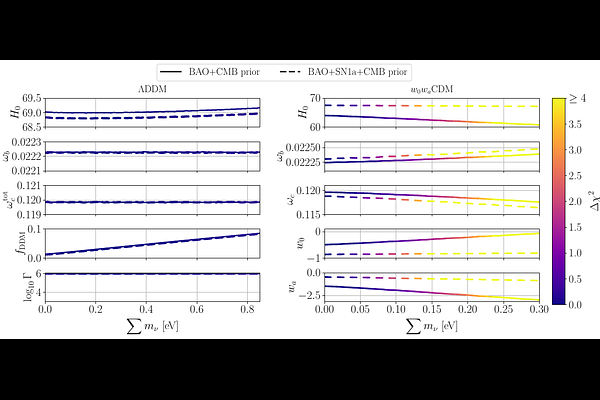
AbstractWe revisit cosmological neutrino mass bounds when a fraction of dark matter is allowed to decay to massless dark radiation. By compensating the late-time increase in the matter density induced by neutrinos becoming non-relativistic, decaying dark matter (DDM) can render datasets solely sensitive to the background density effectively insensitive to neutrino masses. Using data from baryonic acoustic oscillations (BAO) and Type Ia supernovae together with a distance prior from the cosmic microwave background (CMB), we find that neutrino masses as large as ${\cal O}(1\,\mathrm{eV})$ are allowed without degrading the fit. Moreover, the combination of BAO data with the CMB distance prior yields a preference for a non-zero DDM fraction, and alleviates the need for dynamical dark energy with phantom crossing. However, the degeneracy introduced by DDM is decisively broken once perturbation observables are included. Incorporating the full $\textit{Planck}$ CMB likelihood, and in particular CMB lensing, restores strong constraints on the neutrino mass in the DDM scenario, $\sum m_ν\lesssim 0.079\,\mathrm{eV}$. In contrast, neutrino mass constraints in a smooth dark energy model described by the Chevallier-Polarski-Linder parametrization become merely $\sim 25\%$ stronger compared to background-only analyses. Our results highlight the essential role of structure-growth measurements in assessing extensions of the dark sector and to obtain robust cosmological neutrino mass bounds.