Can scrambling protect quantum state distinguishability under noise?

Can scrambling protect quantum state distinguishability under noise?
Guoding Liu, Chushi Qin, Zitai Xu, Xiongfeng Ma, Zi-Wen Liu
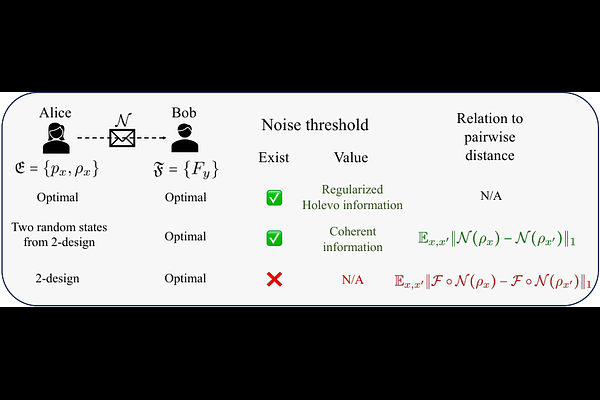
AbstractQuantum state distinguishability is a fundamental concept in quantum information science that underpins a wide range of important practical tasks. Traditionally formulated for pairs of states, quantum state distinguishability is here extended to quantum state ensembles, which we characterize through the average pairwise trace distance. Motivated by both theoretical and practical interest in noisy quantum information processing, we ask whether ``minimally'' scrambled ensembles modeled by 2-designs protect distinguishability under noise, which sheds light on the fundamental competition between noise and information scrambling. Using a rigorous decoupling approach, we establish tight bounds on noisy ensemble distinguishability. We show that the distinguishability of noisy 2-design ensembles exhibits a sharp threshold and phase-transition behavior governed by channel conditional entropy: below the threshold, the states remain mutually distinguishable with high probability, while above it, distinguishability undergoes a sudden power-law decay and then collapses exponentially. On the other hand, under local purity-shrinking noise, post-measured noisy 2-design ensembles become exponentially indistinguishable for any measurement, precluding a noise threshold for learning tasks such as shadow tomography. These results reveal a sharp difference between unmeasured and post-measured scrambled ensembles: the former can retain high distinguishability for sufficiently small noise, whereas the latter exhibits no such protected regime. We discuss the implications of these results for crucial tasks ranging from quantum communication and cryptography to learning.