Emergent structure in the binary black hole mass distribution and implications for population-based cosmology

Emergent structure in the binary black hole mass distribution and implications for population-based cosmology
Vasco Gennari, Tom Bertheas, Nicola Tamanini
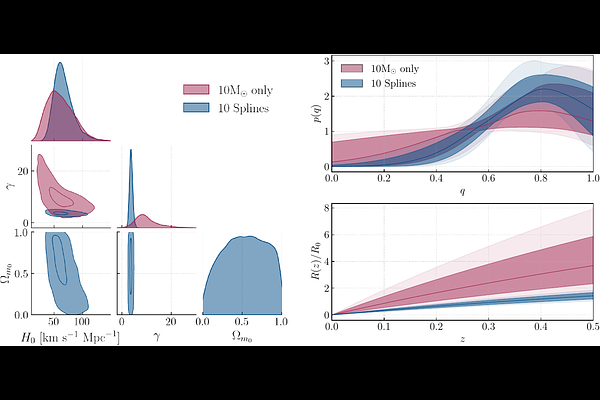
AbstractGravitational waves provide a powerful probe of both the astrophysical processes driving black hole mergers and the dynamics of the Universe, but these measurements rely on accurately inferring the unknown underlying population. We perform an agnostic reconstruction of the primary mass distribution using B-splines, characterising the emergence of structure with increasing model complexity. Using the latest gravitational-wave transient catalog, GWTC-4.0, we identify multiple mass features and find evidence suggesting a logarithmic hierarchy in the population. We show that this structure directly impacts measurements of the Hubble constant, primarily through features at the population boundaries. Finally, we introduce an approach that isolates a subpopulation of low-mass events to mitigate modelling systematics, providing a promising path toward robust population-based cosmology with future datasets.