Nemesis: A Multi-Scale, Multi-Physics Algorithm for Astrophysics

Nemesis: A Multi-Scale, Multi-Physics Algorithm for Astrophysics
Erwan Hochart, Simon Portegies Zwart
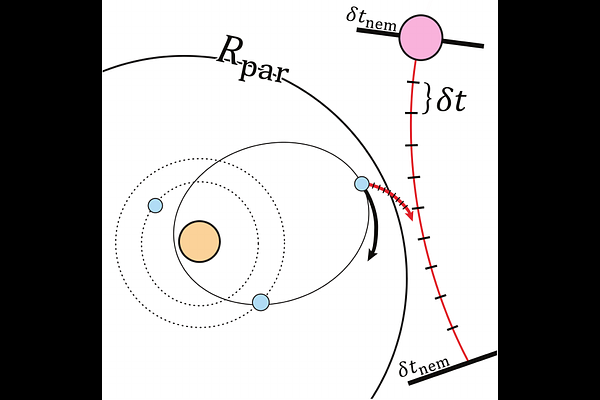
AbstractIn this work, an updated version of the multi-scale, multi-physics algorithm, Nemesis which makes use of the Astrophysical Multipurpose Software Environment (AMUSE). The algorithm is formally introduced and validated. A suite of simulations is run to assess its performance in simulating star clusters containing planetary systems, its ability to capture the von Zeipel-Lidov-Kozai effect, and its computational scalability. Nemesis is found to yield indistinguishable results in both the global and local scales when compared with the direct N-body code Ph4. The same conclusion is found when analysing its ability to capture the von Zeipel-Lidov-Kozai effect. When analysing its computational performance, the wall-clock time scales roughly as $t_{\rm sim \propto 1/ \sqrt{δt_{\rm nem}}$ where $δt_{\rm nem}$ represents the time synchronisation between the global and local scales. When changing the number of planetary systems, the wall-clock time remains unchanged as long as the number of available cores exceeds the number of systems. Beyond this, it's found that at worst, the computational time increases linearly with the number of excess systems. The method introduced here can find it's use in numerous domains of astronomy thanks to its flexibility and modularity, from simulating protoplanetary disks in star clusters to binary black holes in the galactic center.