Efficient and Practical Black-Box Verification of Quantum Metric Learning Algorithms

Efficient and Practical Black-Box Verification of Quantum Metric Learning Algorithms
Ahmed Shokry, Movahhed Sadeghi, Mahmut Kandemir
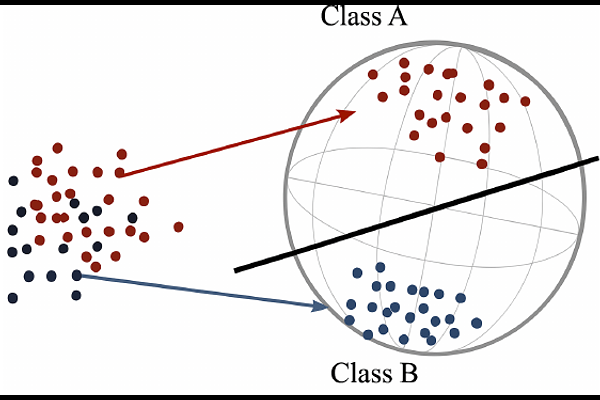
AbstractQuantum metric learning enhances machine learning by mapping classical data to a quantum Hilbert space with maximal separation between classes. However, on current NISQ hardware, this mapping process itself is prone to errors and could be fundamentally incorrect. Verifying that a quantum embedding model successfully achieves its promised separation is essential to ensure the correctness and reliability. In this paper, we propose a practical black-box verification protocol to audit the performance of quantum metric learning models. We define a setting with two parties: a powerful but untrusted prover, who claims to have a parameterized unitary circuit that embeds classical data from different groups with a guaranteed angular separation, and a limited verifier, whose quantum capabilities are restricted to performing only basic measurements. The verifier has no knowledge of the implementation of the prover, including the structure of the model, its parameters, or the details of the prover measurement setup. To verify the separation between different data groups, the proposed algorithm must overcome two key challenges. First, the verifier is ignorant of the prover's implementation details, such as the optimization cost function and measurement setup. Consequently, the verifier lacks any prior information about the expected quantum embedding states for each group. Second, the destructive nature of quantum measurements prevents direct estimation of the separation angles. Our algorithm successfully overcomes these challenges, enabling the verifier to accurately estimate the true separation angles between the different groups. We implemented the proposed protocol and deployed it to verify the QAOAEmbedding models. The results from both theoretical analysis and practical implementation show that our proposal effectively assesses embedding quality and remains robust in adversarial settings.