Extreme-mass ratio inspirals in Schwarzschild - de Sitter spacetime I: Weak-field orbits

Extreme-mass ratio inspirals in Schwarzschild - de Sitter spacetime I: Weak-field orbits
John Adrian N. Villanueva, Ian Vega
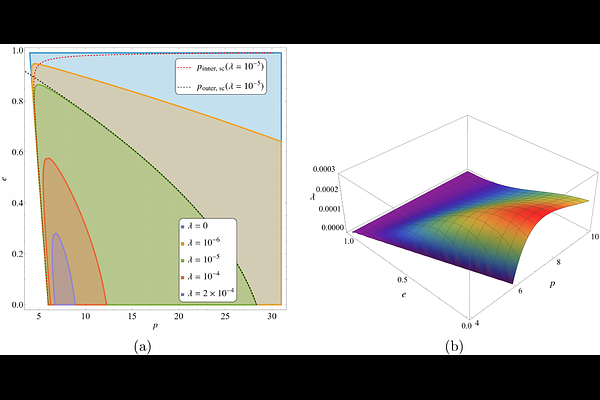
AbstractThe inspiral of a compact object into a black hole is a key source of low-frequency gravitational waves for future space-based detectors like LISA. While models of this process have advanced, they typically focus on asymptotically flat spacetimes. In this paper, we explore how the absence of asymptotic flatness affects the slow, adiabatic orbital evolution due to radiation reaction. This lack of asymptotic flatness can arise from external environments or an expanding universe. Using the Schwarzschild-de Sitter (SdS) spacetime, where the deviation from flatness is governed by the cosmological constant, we study bound orbits characterized by their semi-latus rectum $p$ and eccentricity $e$. We calculate how the cosmological constant shifts the separatrix between bound and plunging orbits and alters the relationship between the binary's binding energy, angular momentum, and orbital parameters. Assuming the orbital timescale is much shorter than the inspiral timescale, we apply a modified quadrupole formula to examine the impact of a small positive cosmological constant on the orbital evolution in the weak-field limit. We find that the cosmological constant accelerates the decrease in eccentricity, reducing inspiral plunge times, which could influence event rate estimates for space-based detectors.