Multiple blobs following a coronal mass ejection

Multiple blobs following a coronal mass ejection
Qing-Min Zhang, Jin-Han Guo, Jie Chen, Zong-Yi Li, Yi-Wei Ni, Yan-Jie Zhang
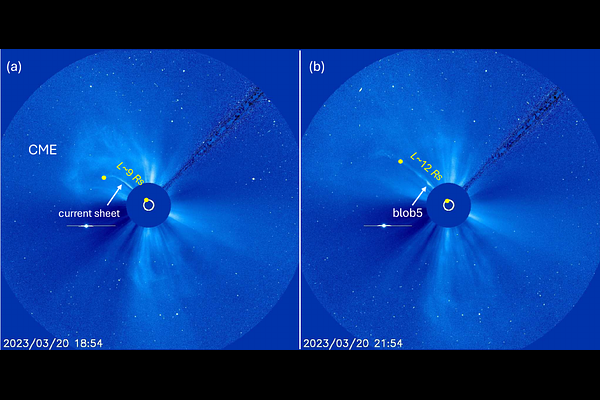
AbstractIn this paper, we study a partial filament eruption, which generated a C4.1 class two-ribbon flare and a wide coronal mass ejection (CME) propagating in the northeast direction on 2023 March 20. The long, sigmoidal filament in active region 13258 is composed of two parts: the eruptive part and remaining part. Both of them are supported by magnetic flux ropes. The separation of two ribbons persist for ~12 hr, with the separation speeds decreasing from 0.26-5.62 to 0.13-0.53 km/s observed in H$α$ and 304 Å. A thin, curved current sheet follows the CME and extends in the northeast direction. Eight and seven bright blobs are found to move outward along the current sheet observed by SOHO/LASCO and STEREO-A/COR2, respectively. In LASCO images, the apparent speeds, lifetime, maximal height, and width of the blobs are 378-871 km/s, 7-84 minutes, 2.94-6.25\,$R_{\sun}$, and 38.8-225.4 Mm. In COR2 images, the apparent speeds, lifetime, maximal height, and width of the blobs are 336-712 km/s, 20-100 minutes, 4.09-7.61\,$R_{\sun}$, and 102.9-318.3 Mm. A positive correlation is found between the lifetime and maximal height, suggesting that blobs with longer lifetime propagate further from the solar surface. The total duration of blobs is >8 hr, which is consistent with ongoing flare reconnection manifested by persistent ribbon separation in the chromosphere. The aspect ratio (28-37) of the current sheet is probably larger than the critical value, suggesting that the blobs following the CME are possibly generated by tearing-mode instability of the current sheet.