Component masses in stellar and substellar binaries from Gaia astrometry and photometry

Component masses in stellar and substellar binaries from Gaia astrometry and photometry
C. A. L. Bailer-Jones, L. Kreidberg
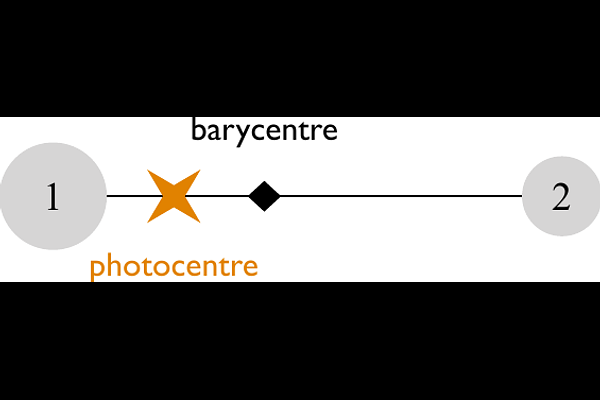
AbstractThe masses of stars and planets can be measured dynamically in binary systems. For an unresolved binary, time series astrometry yields some orbital parameters, but it cannot provide the component masses, because we observe only the motion of the system's photocentre. However, as a star's luminosity is related to its mass, the observable photometry of both components together provides information on the system mass. Here we develop a method to determine the individual component masses of an unresolved binary using the astrometric orbit together with three-band photometry from Gaia. We use a mass-flux relation fitted from stellar isochrone models for each Gaia band to infer the unknown flux ratio. This enables our method to distinguish between near equal-mass, near equal-brightness stellar binaries and star-planet binaries, which otherwise have identical astrometric signatures. Using a likelihood approach, we sample the posterior probability distribution over the stellar parameters, marginalizing over system age and metallicity to get the individual masses. We apply this to 20 000 systems with a main sequence primary within 300 pc of the Sun using data from the Gaia data release 3 non-single star catalogue. Primary masses can be determined with a precision (one-sigma posterior width) of 10-20% in 90% of cases. Secondary masses, which extend down to planetary-mass objects, are less precise, although half are more than 25% precise. Interestingly, adding either infrared photometry or spectroscopic orbits from Gaia does not change the mass estimates much (less than 4% and 1% respectively). Interstellar extinction likewise has little impact for this sample. This work shows that reasonably precise masses can be obtained for stars and substellar objects using just the Gaia astrometry and photometry without need for extensive follow-up.