JWST Confirmation of a Runaway Supermassive Black Hole via its Supersonic Bow Shock

JWST Confirmation of a Runaway Supermassive Black Hole via its Supersonic Bow Shock
Pieter van Dokkum, Connor Jennings, Imad Pasha, Charlie Conroy, Ish Kaul, Roberto Abraham, Shany Danieli, Aaron J. Romanowsky, Grant Tremblay
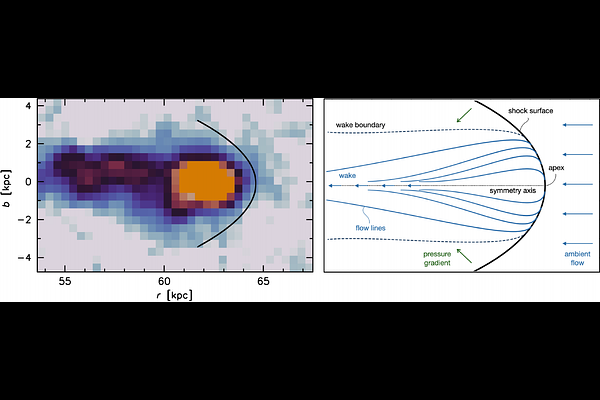
AbstractWe present JWST/NIRSpec IFU observations of a candidate runaway supermassive black hole at the tip of a 62 kpc-long linear feature at z=0.96. The JWST data show a sharp kinematic discontinuity at the tip, with a radial velocity change of $\approx 600$ km/s across 0.1'' (1 kpc). The velocity gradient, together with the projected post-shock flow velocity of $\approx 300$ km/s, is well described by a simple shock-compression model of a supersonic object, with a velocity of $v_{BH} = 954^{+110}_{-126}$ km/s and an inclination $i=29^{+6}_{-3}$ deg. The previously puzzling kinematics along the linear feature, with the observed radial velocity decreasing from $\approx 300$ km/s near the tip to $\approx 100$ km/s closer to the former host galaxy, are naturally explained as gradual downstream mixing of shocked gas with the circumgalactic medium through turbulent entrainment. The runaway black hole interpretation is further supported by the morphology of the gas at the tip of the wake and an analysis of the [OIII]/H$α$, [NII]/H$α$, [SII]/H$α$, and [SIII]/[SII] line ratios. The line ratios are consistent with fast radiative shocks and rapid cooling, with best-fit shock velocities that are in good agreement with expectations from the black hole velocity and the shock geometry. Energy conservation over the lifetime of the wake suggests a SMBH mass of $M_{BH} \gtrsim 10^7$ M$_{\odot}$. These results confirm that the wake is powered by a supersonic runaway supermassive black hole, a long-predicted consequence of gravitational-wave recoil or multi-body ejection from galactic nuclei.