The Atacama Large Aperture Submillimeter Telescope (AtLAST): enabling large-scale sub-mm science beyond 2030

The Atacama Large Aperture Submillimeter Telescope (AtLAST): enabling large-scale sub-mm science beyond 2030
Claudia Cicone, Tony Mroczkowski, Evanthia Hatziminaoglou, Matthias Reichert, Sabrina Sartori, Amelie Saintonge, Pamela Klaassen, Francisco Montenegro-Montes, Martin Timpe, Aleksej Kiselev, Danilo Koeltzsch, Carlos De Breuck, Pamela Pizarro, Eelco van Kampen, Tinus Stander, Dirk Muders, Yiqing Song, Kotaro Kohno, Sergio Poppi, Yoichi Tamura, Stefan Thoms, Hans Kaercher, Sven Wedemeyer, Alessandro Attoli, Stephen Molyneux, Bruno Silva, Guillermo Valenzuela Venegas, Paola Velasco-Herrejon, Marianne Zeyringer, Yogesh Kumar Yadav, Mark Booth, Carlos Alberto Duran, Lars-Ake Nyman, Serni Ribo, Francisca Kemper, Manuel Groh, Leandro Aggio, Mathias Hudoba de Badyn, Benjamin Magnelli, Mats Kirkaune, Akira Endo
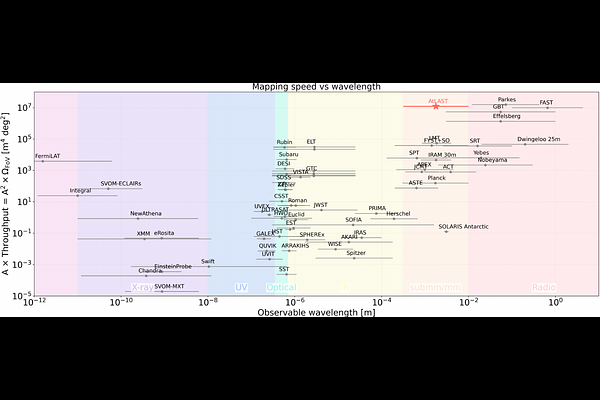
AbstractAtLAST is designed to be the largest (sub-)mm single-dish astronomical observatory and the first climate-neutral modern research infrastructure. It offers a unique combination of large aperture (50 m), large field of view (>1 deg), fast scanning speed (up to 3 deg/s), and high surface accuracy (20micron nighttime half wavefront error) that allows >=50% Ruze efficiency up to 1 THz. The design features a rocking chair mount with an active main reflector surface, a high precision closed-loop metrology system, and the space to house six major instruments. Instruments will be periodically updated as spectroscopic focal plane array, detector, coherent amplifier, and semiconductor technologies used in readout and backend electronics will advance over the next decades. AtLAST will be a multi-purpose facility that will produce transformational results in nearly all fields of Astrophysics, such as Astrochemistry, Galactic and Extragalactic Astronomy, Cosmology, Planetary science, Stellar and Solar Physics, High energy astrophysics, and Time domain astronomy. Its unrivalled throughput of 6170 m^2 deg^2 will enable wide-field unbiased surveys. These will overcome extragalactic confusion noise and enable the detection of normal galaxy populations out to z=7. AtLAST will reveal and characterise the missing baryons in the Universe, by mapping the elusive, low surface brightness gas within and around galaxies across cosmic time. AtLAST will be the first green off-grid observatory, powered by a bespoke renewable energy system and reusing its braking energy thanks to a cutting-edge energy recovery system. By sharing surplus power and technological know-how with local communities, AtLAST will contribute to energy justice in Chile. AtLAST's new bold vision of a sustainable pursuit of breakthrough astronomy is an exceptional opportunity to shape the future of scientific research infrastructures. [abridged]