Active chromospheric fibril singularity: Coordinated observations from Solar Orbiter, SST, and IRIS

Active chromospheric fibril singularity: Coordinated observations from Solar Orbiter, SST, and IRIS
Reetika Joshi, Luc Rouppe van der Voort, Guillaume Aulanier, Sanja Danilovic, Avijeet Prasad, Carlos J. Díaz Baso, Daniel Nóbrega-Siverio, Nicolas Poirier, Daniele Calchetti
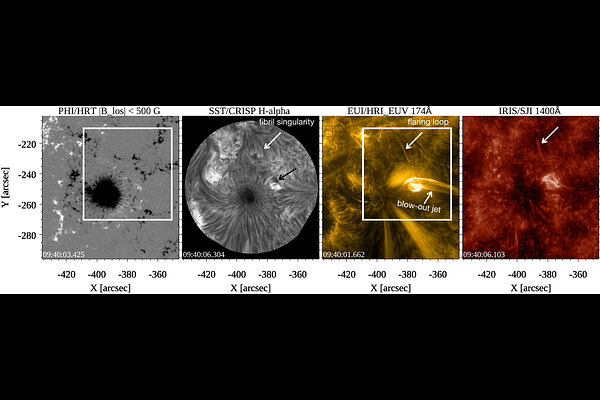
AbstractThe fine structures of the solar chromosphere, driven by photospheric motions, play a crucial role in the dynamics of solar magnetic fields. Many have been already identified such as fibrils, filament feet, and arch filament systems. Still, high resolution observations show a wealth of structures that remain elusive. We have observed a puzzling, unprecedented chromospheric fibril singularity in close vicinity of a blow-out solar jet and a flaring loop. We aim to understand the magnetic nature of this singularity and the cause of its activity using coordinated high- resolution multi-wavelengths observations. We aligned datasets from Solar Orbiter, SST, IRIS, and SDO. We re-projected the Solar Orbiter datasets to match the perspective of the Earth-based instruments. We performed potential field extrapolations from Solar Orbiter/PHI data. We analysed the spatial and temporal evolution of the plasma structures and their link with the surface magnetic field. This leads us to derive a model and scenario for the observed structures which we explain in a general schematic representation. We have discovered a new feature, a singularity in the chromospheric fibril pattern. It is formed in a weak magnetic field corridor between two flux concentrations of equal sign, at the base of a vertically inverted-Y shape field line pattern. In this specific case some activity develops along the structure. Firstly a flaring loop at one end, secondly a blow-out jet at the other end, where a coronal null-point was present and associated with a chromospheric saddle point being located onto the fibril singularity. The observations sugge