The many boundaries of the stratified dark matter halo

The many boundaries of the stratified dark matter halo
Jiaxin Han
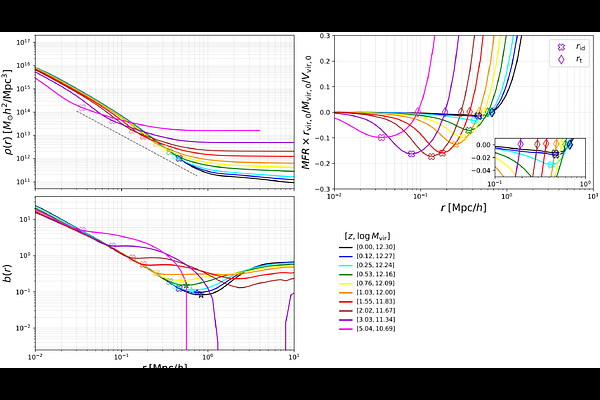
AbstractWe review the physics of halo collapse giving rise to various halo boundaries, as well as their identification, observation, and applications. The classical halo is typically defined as a monolithic, virialized object enclosed within its virial radius -- a definition which, however, does not account for ongoing halo growth. Continuous accretion causes the orbits of infalling particles to shrink over time, confining newly accreted material in a growing layer outside the virialized region. Several novel halo boundaries, such as the splashback and depletion radii, have recently been proposed to characterize this growth layer from different perspectives. Along with the turnaround radius, which operates on an even larger scale to enclose the entire infall region, these multiple boundaries comprise an extended view of a dark matter halo as a stratified structure. Theoretical models can largely explain the existence of various boundaries, while challenges remain in providing unified and quantitative predictions of their properties. The multiple boundaries open new avenues for observing halo growth and may substantially improve our understanding and modeling of cosmic structure formation. We provide a python package, SpheriC, implementing the key spherical collapse models.