Testing $Λ$CDM versus dynamical dark energy in one year: A DESI spectroscopic follow-up program for Rubin supernovae

Testing $Λ$CDM versus dynamical dark energy in one year: A DESI spectroscopic follow-up program for Rubin supernovae
Jannik Truong, Greg Aldering, Saul Perlmutter, David Rubin, David Schlegel
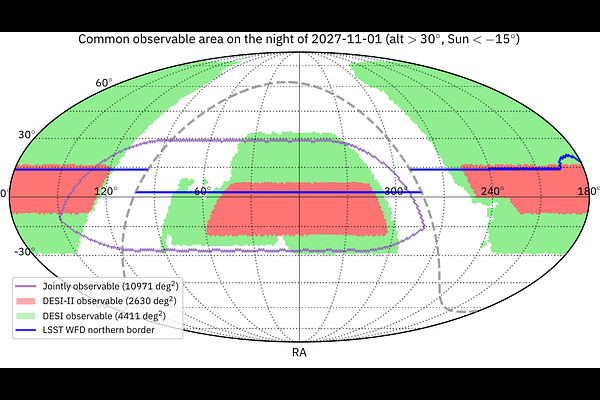
AbstractCombined cosmological probes currently indicate that best-fit values in the $w_0-w_a$ parametrization of dynamical dark energy deviate from $Λ$CDM by $\sim3σ$. In this work, we present a supernova survey capable of measuring dynamical dark energy at the $>5σ$ level with just one year of data, starting in 2027. We first show that with the present values of $w_0$ and $w_a$, new SNe Ia at redshifts $z\lesssim0.6$ near dark energy-matter equality would add the most constraining power. This is well within reach of the Vera C. Rubin Observatory and the Dark Energy Spectroscopic Instrument (DESI). Because cosmology measurements with SNe Ia quickly become systematics-limited, we focus on eliminating key systematics by using only a spectroscopically confirmed and volume-limited sample. In our proposed survey, SN alerts from Rubin would actively re-prioritize the scheduling of already-planned DESI tile visits. This would yield 7 500 near-peak transient spectra in one year without delaying DESI's primary survey. We forecast that if current best-fit $w_0-w_a$ values persist, combining just our volume-limited subset of 2 300 new SNe Ia at $z<0.3$ with current SN, BAO, and CMB data would push the tension with $Λ$CDM beyond $5σ$. This applies across a wide range of assumed uncertainties. To further circumvent systematics, we explore how DESI enables spectroscopic standardization via machine learning, offering a path toward a cosmology measurement independent of light-curve-based standardization. Finally, we discuss how early results from this program could inform future dark energy experiments.