TWIN-2: Timing Solar Radio Bursts between 180-350 MHz Against GOES and Aditya-L1 X-ray Detections

TWIN-2: Timing Solar Radio Bursts between 180-350 MHz Against GOES and Aditya-L1 X-ray Detections
Paneendra G N, Vinod K R, Arul Pandian B, Abhishek R, Susan Syeda, Chandana R, Dhanushree V, Ishwarya T, Manasa K N, Shiekh Saniya, Suresh A, Yashwanth R, Supriya Nayaka M K, Prabu T
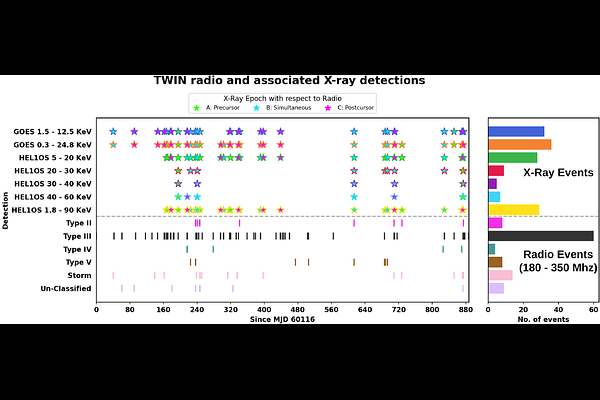
AbstractWe have conducted continuous solar observations for approximately two and half years using the Two-Element Interferometer (TWIN) at Gauribidanur Radio Observatory (RRI). During which several solar events have been detected. Our observational period coincides with the maximum events phase of the Solar Cycle 25, providing us opportunity to analyse the evolution of the solar activity. Our analysis of two and half years data show a clear increase in the occurrences of solar events, which is consistent with the expected rise in the solar activity towards the peak phase of the Solar Cycle 25. We further investigate the detected solar radio events using X-ray observations from the space based Aditya-L1 and the Geostationary Operational Environmental Satellites (GOES) satellites. For the automated detection of SRBs, a machine learning suite has been trained. This also serves as an instrument for space weather monitoring. On the 7th of November 2025, a solar storm was detected by our pipeline in realtime. A brief overview of the data-processing pipeline, along with the RFI mitigation techniques employed to identify and characterize the solar events, is also presented. Observation data of two and a half years of TWIN is available for public access. The data has been used in student training programmes on solar radio data analysis, with students carrying out the analysis and contributing to the initial analysis of the detected events.