The primordial nature of the C-19 stellar stream

The primordial nature of the C-19 stellar stream
Kim A. Venn, Zhen Yuan, Nicolas F. Martin, Anya Dovgal, Daria Zaremba, Else Starkenburg, Felipe Gran, Christian R. Hayes, Vanessa Hill, Chiaki Kobayashi, Carmela Lardo, Alan W. McConnachie, Tadafumi Matsuno, Martin Montelius, Vinicius Placco, Federico Sestito, Anke Ardern-Arentsen, Guiseppina Battaglia, Piercarlo Bonifacio, Raymond Carlberg, Sebastien Fabbro, Morgan Fouesneau, Rodrigo Ibata, Pascale Jablonka, Jaclyn Jensen, Georges Kordopatis, Madelyn McKenzie, Julio F. Navarro, John S. Pazder, Ruben Sanchez-Janssen, Simon T. E. Smith, Akshara Viswanathan, Sara Vitali, Long Wang, Zhen Wang
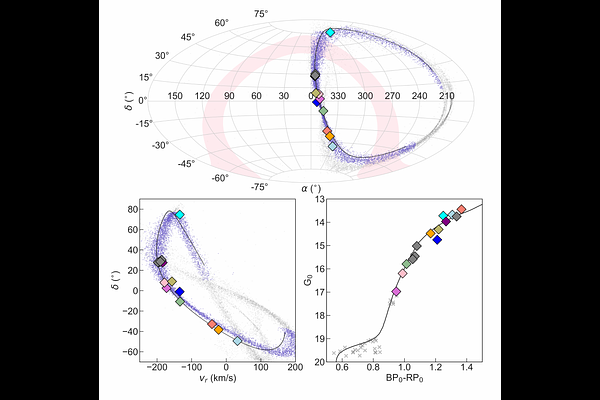
AbstractStellar streams, remnants of compact star systems stretched out by the tidal forces of the Milky Way, offer a unique way to study stellar populations that formed billions of years ago. A particularly unique stream is C-19, the most metal-poor stellar stream known at less than a thousandth of the Sun's metallicity. The nature of C-19 is not yet clear, with properties that resemble both star clusters and ultra faint dwarf galaxies, yet in either case its extremely low metallicity indicates very early star formation, <1 Gyr after the Big Bang. Here, we present the first detailed study on the nature of C-19 based on the chemical abundances of 14 member stars from high-resolution spectroscopy. These reveal that C-19 formed stars in an early, rapid, and prolific star formation event, with mild inhomogeneous mixing of elements produced in massive stars. There is otherwise no evidence for subsequent star formation, multiple stellar populations, nor chemical evolution. Although C-19 is currently disrupted in the Milky Way halo, it offers a rare and complementary window into the details of star formation and chemical evolution in the early universe, ideal for comparisons with current studies of primordial star formation in the high-redshift universe.