Dust in the Average Galaxy: Attenuation, Emission, and Opacity from 0<z<7

Dust in the Average Galaxy: Attenuation, Emission, and Opacity from 0<z<7
Caitlin M. Casey, Hollis B. Akins, Andrew J. Battisti, Jed McKinney, Ezequiel Treister, Jorge A. Zavala, Hiddo Algera, Manuel Aravena, Yingjie Cheng, Nicole E. Drakos, Andreas L. Faisst, Maximilien Franco, Seiji Fujimoto, Ghassem Gozaliasl, Ali Hadi, Santosh Harish, Michaela Hirschmann, Olivier Ilbert, Kohei Inayoshi, Jeyhan S. Kartaltepe, Anton M. Koekemoer, Claudia del P. Lagos, Erini Lambrides, Ronaldo Laishram, Daizhong Liu, Arianna S. Long, Georgios E. Magdis, Sinclaire M. Manning, Crystal L. Martin, Felix Martinez, Richard Massey, Jacqueline E. McCleary, Henry Joy McCracken, Lauro Moscardini, Desika Narayanan, Louise Paquereau, Jason Rhodes, Brant E. Robertson, Rasha M. Samir, Claudia Scarlata, Marko Shuntov, Laura Sommovigo, Aswin P. Vijayan, Wuji Wang, Can Xu, Dhruv Zimmerman
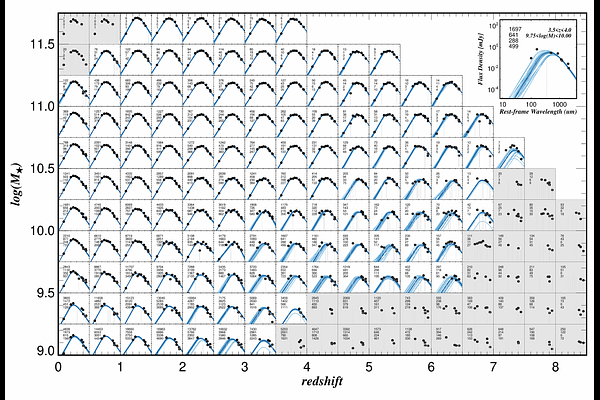
AbstractWe present constraints on the dust emission and attenuation properties of galaxies across 0<z<7 using JWST imaging from the COSMOS-Web Survey combined with deep FIR/(sub)millimeter data from Spitzer, Herschel, SCUBA-2, NIKA-2 and ALMA. We analyze over 500,000 galaxies to independently constrain attenuation in the rest-frame UV/optical as well as dust emission from stacked FIR SEDs, enabling a direct comparison between the two. We find UV/optical attenuation systematically underpredicts IR luminosity by a factor of ~3x at 0.5<z<7 and up to an order of magnitude for $M_\star>10^{10.5}M_\odot$. We derive empirical relationships for the effective attenuation, dust temperature, fraction of star formation that is unobscured, and dust-to-stellar mass ratio as functions of redshift and stellar mass. We separate the first order effect of star/dust geometry from dust grain properties by combining constraints on the IR SED, UV SED, and dust mass surface density. Importantly, we measure over an order of magnitude decrease in $κ_{UV}/κ_{FIR}$--the ratio of dust mass absorption coefficients in the UV at 1600Å and FIR at 500$μ$m--from z~0 to z~7. A depressed $κ_{UV}/κ_{FIR}$ is consistent with a deficit of small dust grains, possibly attributable to the intense radiation fields of high-$z$ star formation; indeed, we find a redshift-invariant inverse relationship between $κ_{UV}/κ_{FIR}$ and $Σ_{SFR}$. Most evolution in the dust-to-stellar ratio is at $z<1$, the product of mild downward evolution in the dust-to-gas ratio combined with steep evolution in the gas-to-stellar ratio. The significant evolution and dynamic range of $κ_{UV}/κ_{FIR}$ and prevailing disconnect between the UV/optical and FIR regimes emphasize that direct dust constraints are irreplaceable for the majority of star-forming galaxies at z<7, not just the most extreme star-formers.