Three dimensional temporal evolution of photochemical haze in exoplanet atmospheres I. Description and test application to HD 189733b

Three dimensional temporal evolution of photochemical haze in exoplanet atmospheres I. Description and test application to HD 189733b
Elspeth K. H. Lee, Maria E. Steinrueck, Kazumasa Ohno, Diana Powell, Xi Zhang
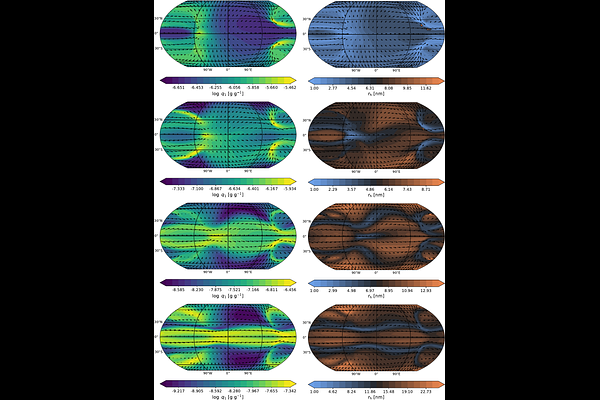
AbstractThe formation and global spatial distribution of photochemically produced haze particles remain a key process in exoplanet atmospheres for understanding their observed properties. We aim to develop a flexible haze particle formation and evolution model suitable for time-dependent exoplanet atmosphere simulations. Inspired by recent 2D photochemical modelling efforts, we include a simple activation timescale mechanism to emulate a delayed formation of solid haze particles. We couple our new microphysical haze formation scheme, mini-haze, to the Exo-FMS general circulation model (GCM) and simulate an idealised HD 189733b case study to examine the 3D spatial distribution and sizes of haze particles. Our results suggest that for our chosen haze formation efficiency, particles do not grow beyond $\sim$30 nm, in line with previous detailed 1D modelling. We find the haze spatial distribution follows the vertical velocity structure of the atmosphere, with equatorial convergence patterns of material deeper in the atmosphere at $\sim$10$^{-2}$ bar. The resulting global distribution leads to enhanced haze opacity at the east and west limbs of the atmosphere. In our test cases, radiative feedback from haze opacity can strongly affect the temperature-pressure structures in the upper atmosphere depending on the production rate. Our synthetic spectra results suggest that longer haze-production timescales give rise to stronger haze opacity effects on the observed transmission spectra compared to short-timescale dayside formation, but the stronger thermal feedback from nightside formation leads to an overall larger dayside emission flux. Our current simulations represent a step towards investigating self-consistent haze formation and evolution with chemical feedback effects in 3D, and can be readily applied to other objects of interest, such as sub-Neptune atmospheres.