Closeby Habitable Exoplanet Survey (CHES). V. Planetary Parameters Derived from Angular Separation Variations

Closeby Habitable Exoplanet Survey (CHES). V. Planetary Parameters Derived from Angular Separation Variations
Dongjie Tan, Jianghui Ji, Chunhui Bao, Xiumin Huang, Guo Chen, Su Wang, Yao Dong, Jiacheng Liu, Zi Zhu, Haitao Li, Junbo Zhang, Liang Fang, Dong Li, Lei Deng
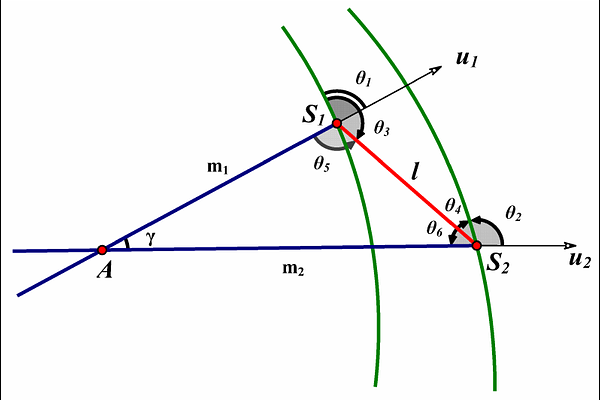
AbstractThe Closeby Habitable Exoplanet Survey (CHES) aims to achieve microarcsecond-level astrometry of about one hundred nearby FGK-type stars within 10 parsecs to detect Earth-like planets. Such precision exceeds the capability of absolute astrometry relying on Gaia catalogs, whose positional accuracy degrades over time due to error propagation from stellar motion and epoch offsets, limiting their use in microarcsecond-level detection. Traditional relative astrometry depends on positional components along right ascension and declination, requiring precise knowledge of field rotation and satellite attitude, which introduces additional errors. To address this, we propose a new relative measurement model based solely on variations in the length of angular separation between the target and reference stars, independent of direction. The model incorporates effects such as proper motion, parallax, radial velocity, light aberration, gravitational lensing, and planetary perturbations, enabling reconstruction of planetary orbits and masses. This approach enhances measurement stability and precision, providing a framework that is not entirely dependent on the Gaia catalog and suitable for CHES and other future high-accuracy astrometric missions.