Finding and characterising physical states of Euclidean Abelianized loop quantum gravity using neural quantum states

Finding and characterising physical states of Euclidean Abelianized loop quantum gravity using neural quantum states
Hanno Sahlmann, Waleed Sherif
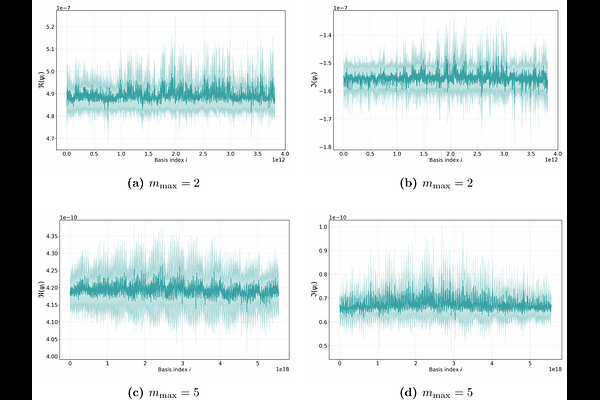
AbstractWe study physical (near-kernel of constraints) states of 4-d Euclidean loop quantum gravity in Smolin's weak coupling limit on the complete graph $K_5$ using variational Monte Carlo with neural network quantum states. We investigate the Hamilton constraint $\hat{H}$ in the ordering proposed by Thiemann, as well as $\hat{H}^\dagger$ and $\hat{H}+\hat{H}^\dagger$. We find that the variational optimisation selects distinct solution families for $\hat{H}$ and $\hat{H}^\dagger$ across several considered cutoffs on the kinematical degrees of freedom. The solution family of $\hat{H}$ is flat on all minimal loops and has non-vanishing volume expectation values. Its edge-charge marginals delocalise with increasing cutoff, which indicates they are approximations to solutions that are non-normalisable in the kinematical inner product. The solution family for $\hat{H}^\dagger$ is normalisable, shows non-trivial charge correlations, lies in the kernel of volume and is not flat. $\hat{H}+\hat{H}^\dagger$ turns out to be much harder to solve and yields quasi-solutions combining features of both previous families. We characterise all solutions using chromaticity 1- and 2-point functions, minimal loop holonomies, geometric area and volume observables and show that the two families can be interpreted as, on the one hand, a family of states close to the Ashtekar-Lewandowski vacuum and the Dittrich-Geiller vacuum with some numerical noise on the other hand. We also present some results that link solutions of the truncated theory to solutions of the continuum theory.